

The floor contractor installing a floor not only has to deal with the floor planks themselves, but also with all other materials in contact with or surrounding the floor he is about to install.
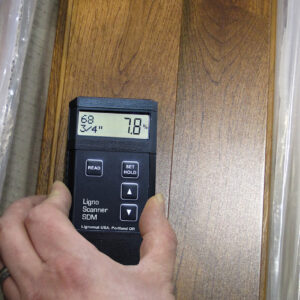
Checking wood flooring moisture content with a meter before installation
The first consideration is the moisture content of the floor planks as delivered by the floor manufacturer to the site. A moisture meter is needed to confirm this moisture content. If there are already discrepancies between the actual measured moisture content and the expected moisture content standard of 6-9%, the floor manufacturer should be informed immediately.
Floor problems start when the moisture content of the floor planks changes. When moisture changes, wood expands or shrinks. Floor planks may cup, crown, buckle or develop cracks. Even a perfectly installed floor can show defects when the moisture changes, which actually should be avoided by ensuring an equilibrium among the materials surrounding the floor and the relative humidity of the surrounding air, so that no changes in moisture content occur.
Recommendations for relative humidity in buildings range from 30% – 50%.
Recommendations for ambient temperature in buildings range from 60°F – 80°F.
If ambient conditions stay within the recommended ranges, the EMC (equilibrium moisture content) of wood stays between 6% and 9%. Should the moisture content fluctuates within this given range, the amount of expansion and contraction of wood is limited.
Examples:
1) If kept at a relative humidity of 40% and a temperature of 70°F, lumber at 7.7% will not change its moisture content.
2) Conditions in a warehouse are 60% relative humidity at 50°F. If dry wood is left in the warehouse for an extended period of time, it will pick up moisture until 11.2% wood moisture is reached, regardless of wood species and initial moisture content.
Here are some important facts that can disturb the equilibrium and make floor planks shrink or expand.
Subfloor does not have the appropriate moisture content and releases moisture into the floor planks. Here the manufacturer’s guidelines are to be followed. The guidelines specify the correct subfloor medium and the appropriate moisture range relative to the floor planks. A moisture meter is essential to make sure the moisture content of the subfloor is within the required range compared to the floor planks.
Concrete as substrate. Again, follow the manufacturer’s guidelines. If moisture testing is required, the in-situ probe test is now the industry standard. The problem with handheld moisture meter testing is that, even if they measure 1” deep, are not sufficient to detect excess moisture hidden below that measuring depth. The in-situ probe test, however, reaches deep enough to identify high moisture levels. If left undetected, this excess moisture could eventually creep to the surface after floor installation and be absorbed by the wood. Moisture evaporation from concrete subfloors can be controlled by using the correct vapor barrier as is now often recommended by the wood floor manufacturer.
Air: Recommendations for relative humidity in buildings range from 30% – 50%.
Recommendations for ambient temperature in buildings range from 60°F – 80°F.
If ambient conditions remain within the recommended ranges, the EMC of wood stays between 6% and 9%. If the moisture content changes within that given range, the amount of expansion and contraction of wood is limited.
Floor planks, subfloor, and concrete underneath all influence each other. For a successful installation and a lasting floor, they should stay in an equilibrium.

Necessary tools for moisture assessment: mini-Ligno DX/C (pin meter), Ligno-VersaTec (pin, pinless, and in-situ RH combination moisture meter), and thermo-hygrometer.
Floor, subfloor, concrete substrate and surrounding air build the environment for the floor. Necessary tools include a handheld moisture meter, preferably pin and pinless, an in-situ RH moisture measuring kit, and an accurate thermo-hygrometer.
The floor installer is well advised to document the moisture values after the installation to cover his responsibility and to state the condition at the time when he handed the floor over to the new owner. These measurements are essential if later problems arise, as they serve as the starting point for investigations.
→ Click for more info on Lignomat mini-Ligno DX pin moiture meter.
→ Click for more info on Lignomat Ligno VersaTec pin-pinless-RH moiture meter.
→ Click for more info on Thermo-Hygrometer.